If this is your first visit, be sure to
check out the FAQ by clicking the
link above. You may have to register
before you can post: click the register link above to proceed. To start viewing messages,
select the forum that you want to visit from the selection below.
Policy / Politique
The fee for tournament organizers advertising on ChessTalk is $20/event or $100/yearly unlimited for the year.
Les frais d'inscription des organisateurs de tournoi sur ChessTalk sont de 20 $/événement ou de 100 $/année illimitée.
You can etransfer to Henry Lam at chesstalkforum at gmail dot com
Transfér à Henry Lam à chesstalkforum@gmail.com
Dark Knight / Le Chevalier Noir
General Guidelines
---- Nous avons besoin d'un traduction français!
Some Basics
1. Under Board "Frequently Asked Questions" (FAQs) there are 3 sections dealing with General Forum Usage, User Profile Features, and Reading and Posting Messages. These deal with everything from Avatars to Your Notifications. Most general technical questions are covered there. Here is a link to the FAQs. https://forum.chesstalk.com/help
2. Consider using the SEARCH button if you are looking for information. You may find your question has already been answered in a previous thread.
3. If you've looked for an answer to a question, and not found one, then you should consider asking your question in a new thread. For example, there have already been questions and discussion regarding: how to do chess diagrams (FENs); crosstables that line up properly; and the numerous little “glitches” that every new site will have.
4. Read pinned or sticky threads, like this one, if they look important. This applies especially to newcomers.
5. Read the thread you're posting in before you post. There are a variety of ways to look at a thread. These are covered under “Display Modes”.
6. Thread titles: please provide some details in your thread title. This is useful for a number of reasons. It helps ChessTalk members to quickly skim the threads. It prevents duplication of threads. And so on.
7. Unnecessary thread proliferation (e.g., deliberately creating a new thread that duplicates existing discussion) is discouraged. Look to see if a thread on your topic may have already been started and, if so, consider adding your contribution to the pre-existing thread. However, starting new threads to explore side-issues that are not relevant to the original subject is strongly encouraged. A single thread on the Canadian Open, with hundreds of posts on multiple sub-topics, is no better than a dozen threads on the Open covering only a few topics. Use your good judgment when starting a new thread.
8. If and/or when sub-forums are created, please make sure to create threads in the proper place.
Debate
9. Give an opinion and back it up with a reason. Throwaway comments such as "Game X pwnz because my friend and I think so!" could be considered pointless at best, and inflammatory at worst.
10. Try to give your own opinions, not simply those copied and pasted from reviews or opinions of your friends.
Unacceptable behavior and warnings
11. In registering here at ChessTalk please note that the same or similar rules apply here as applied at the previous Boardhost message board. In particular, the following content is not permitted to appear in any messages:
* Racism
* Hatred
* Harassment
* Adult content
* Obscene material
* Nudity or pornography
* Material that infringes intellectual property or other proprietary rights of any party
* Material the posting of which is tortious or violates a contractual or fiduciary obligation you or we owe to another party
* Piracy, hacking, viruses, worms, or warez
* Spam
* Any illegal content
* unapproved Commercial banner advertisements or revenue-generating links
* Any link to or any images from a site containing any material outlined in these restrictions
* Any material deemed offensive or inappropriate by the Board staff
12. Users are welcome to challenge other points of view and opinions, but should do so respectfully. Personal attacks on others will not be tolerated. Posts and threads with unacceptable content can be closed or deleted altogether. Furthermore, a range of sanctions are possible - from a simple warning to a temporary or even a permanent banning from ChessTalk.
Helping to Moderate
13. 'Report' links (an exclamation mark inside a triangle) can be found in many places throughout the board. These links allow users to alert the board staff to anything which is offensive, objectionable or illegal. Please consider using this feature if the need arises.
Advice for free
14. You should exercise the same caution with Private Messages as you would with any public posting.
The procedure from the diagram in post 45 is 1.Bd7 , Ke3 The black king has to hold off the white king as it slowly goes up the board. (for example if 1...Kf3 2.Kd4, kf4 then 3.h4! and the black king is cutoff from advancing further)
2.h4, Ke4 3.h5, Ke5 4.h6, Kf6 and now the white bishop cuts off the black king with 5.Be8
Now the black king cant go Ke7 because it is too far from the queening pawn, therefore the black king is cutoff and the pawn queens.
Last edited by Hans Jung; Monday, 6th April, 2026, 04:48 PM.
The complete story (that I never knew until now) was that the original position was the end of a game between two amateurs in Scotland in 1875. The final position was agreed drawn although the black king was on h1.
Twenty years later Georges Barbier in his chess column in The Glasgow Weekly Citizen published the final position with the caption: "White to move and win". In his next column he moved the black king from h1 to a1 and now the caption read: "Black to play and draw".
The Spanish priest Fernando Saavedra, who was living in Scotland at the time studied the column and discovered that White had a win and so it was named after him.
The study version is by Emanuel Lasker who added the White first move and that is how the position and resulting moves became so famous.
The complete story (that I never knew until now) was that the original position was the end of a game between two amateurs in Scotland in 1875. The final position was agreed drawn although the black king was on h1.
Twenty years later Georges Barbier in his chess column in The Glasgow Weekly Citizen published the final position with the caption: "White to move and win". In his next column he moved the black king from h1 to a1 and now the caption read: "Black to play and draw".
The Spanish priest Fernando Saavedra, who was living in Scotland at the time studied the column and discovered that White had a win and so it was named after him.
The study version is by Emanuel Lasker who added the White first move and that is how the position and resulting moves became so famous.
Alas, I forget the name of the Dutch author who issued very small editions of a truly specialist chess nature sometimes only 25 copies in the early 2000s. They were professionally produced. I was lucky enough to be on his selling list. One of his books was on the Saavedra position, a complete history. I don't mean a booklet. I mean a normal size book. There was substantial information available.
I recall this now because I owned a copy of the 1st edition and the 2nd edition. He rarely produced 2nd editions. Eventually about 17 years ago I sold the 2nd edition for $800US on eBay and then the 1st edition privately for $1,000US.
His editions/books had almost become a collector's cult.


 Tweet
Tweet
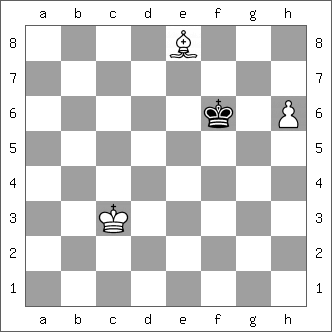 Now the black king cant go Ke7 because it is too far from the queening pawn, therefore the black king is cutoff and the pawn queens.
Comment