If this is your first visit, be sure to
check out the FAQ by clicking the
link above. You may have to register
before you can post: click the register link above to proceed. To start viewing messages,
select the forum that you want to visit from the selection below.
Policy / Politique
The fee for tournament organizers advertising on ChessTalk is $20/event or $100/yearly unlimited for the year.
Les frais d'inscription des organisateurs de tournoi sur ChessTalk sont de 20 $/événement ou de 100 $/année illimitée.
You can etransfer to Henry Lam at chesstalkforum at gmail dot com
Transfér à Henry Lam à chesstalkforum@gmail.com
Dark Knight / Le Chevalier Noir
General Guidelines
---- Nous avons besoin d'un traduction français!
Some Basics
1. Under Board "Frequently Asked Questions" (FAQs) there are 3 sections dealing with General Forum Usage, User Profile Features, and Reading and Posting Messages. These deal with everything from Avatars to Your Notifications. Most general technical questions are covered there. Here is a link to the FAQs. https://forum.chesstalk.com/help
2. Consider using the SEARCH button if you are looking for information. You may find your question has already been answered in a previous thread.
3. If you've looked for an answer to a question, and not found one, then you should consider asking your question in a new thread. For example, there have already been questions and discussion regarding: how to do chess diagrams (FENs); crosstables that line up properly; and the numerous little “glitches” that every new site will have.
4. Read pinned or sticky threads, like this one, if they look important. This applies especially to newcomers.
5. Read the thread you're posting in before you post. There are a variety of ways to look at a thread. These are covered under “Display Modes”.
6. Thread titles: please provide some details in your thread title. This is useful for a number of reasons. It helps ChessTalk members to quickly skim the threads. It prevents duplication of threads. And so on.
7. Unnecessary thread proliferation (e.g., deliberately creating a new thread that duplicates existing discussion) is discouraged. Look to see if a thread on your topic may have already been started and, if so, consider adding your contribution to the pre-existing thread. However, starting new threads to explore side-issues that are not relevant to the original subject is strongly encouraged. A single thread on the Canadian Open, with hundreds of posts on multiple sub-topics, is no better than a dozen threads on the Open covering only a few topics. Use your good judgment when starting a new thread.
8. If and/or when sub-forums are created, please make sure to create threads in the proper place.
Debate
9. Give an opinion and back it up with a reason. Throwaway comments such as "Game X pwnz because my friend and I think so!" could be considered pointless at best, and inflammatory at worst.
10. Try to give your own opinions, not simply those copied and pasted from reviews or opinions of your friends.
Unacceptable behavior and warnings
11. In registering here at ChessTalk please note that the same or similar rules apply here as applied at the previous Boardhost message board. In particular, the following content is not permitted to appear in any messages:
* Racism
* Hatred
* Harassment
* Adult content
* Obscene material
* Nudity or pornography
* Material that infringes intellectual property or other proprietary rights of any party
* Material the posting of which is tortious or violates a contractual or fiduciary obligation you or we owe to another party
* Piracy, hacking, viruses, worms, or warez
* Spam
* Any illegal content
* unapproved Commercial banner advertisements or revenue-generating links
* Any link to or any images from a site containing any material outlined in these restrictions
* Any material deemed offensive or inappropriate by the Board staff
12. Users are welcome to challenge other points of view and opinions, but should do so respectfully. Personal attacks on others will not be tolerated. Posts and threads with unacceptable content can be closed or deleted altogether. Furthermore, a range of sanctions are possible - from a simple warning to a temporary or even a permanent banning from ChessTalk.
Helping to Moderate
13. 'Report' links (an exclamation mark inside a triangle) can be found in many places throughout the board. These links allow users to alert the board staff to anything which is offensive, objectionable or illegal. Please consider using this feature if the need arises.
Advice for free
14. You should exercise the same caution with Private Messages as you would with any public posting.
15. Have fun!
(Thanks to Nigel Hanrahan for writing these up!)
A chess problem solvable by intuition but not by computers
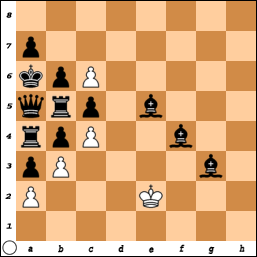
White only moves his king and draws via 50-move rule.
I think you should submit that solution!
I realized that by only moving the King around, Black was paralyzed of course. I also have looked at posting the white K on d7 and then sacrificing the pawn to a Bishop on c7 then moving the White King to c6 to somehow take advantage of the pawn captures that may follow, but I didn't see a lot of opportunity for NOT losing with that idea... :)
Re: A chess problem solvable by intuition but not by computers
Well, yeah, just move the king on the white squares.
As a side note, this position, even if completely ridiculous compared to practical chess, is still of some use in the context of computer analysis. Let me explain.
I enter the position and fire up the latest version of Komodo. What is the output? A steady -25 (huge advantage for black). But I insist on the 'steady' part. The number stays the same whatever the depth of analysis is.
Now, some might say the computer doesn't understand the position, but I partly disagree. The computer doesn't see a mate, so it's not mate in X. And there's too many pieces for a clear evaluation. So a ridiculous number comes out, BUT, the computer doesn't see how to progress. Which immediately tells me it's a draw. I don't care what is the number in the computer's evaluation. What I do care about is the fact that the number stays the same, whether it's at 12 plys or 30. It does tell me that the computer can't find a way to progress, so it's still some valuable insight into the position.
A chess problem solvable by intuition but not by computers
A chess problem solvable by intuition but not by computers
March 13, 2017
The new Penrose Institute has been founded by Sir Roger Penrose, emeritus Professor at the Mathematical Institute of Oxford.
It will study human consciousness through physics and tease out the fundamental differences between artificial and human intelligence.
A chess problem, originally drawn by Sir Roger, has been devised to defeat an artificially intelligent computer but be solvable for humans. The Penrose Institute scientists are inviting readers to workout how white can win or force a stalemate and then share their reasoning.
white to play and draw. Easy for humans. (Note: It is a legal position)
__________
Can you solve the puzzle?
Scientists want to hear from you if you've cracked it
The puzzle above may seem hopeless for white, with just a King and four pawns remaining, but it is possible to draw and even win.
Scientists have constructed it in a way to confound a chess computer, which would normally consider that it is a win for black.
However an average chess-playing human should be able to see that a draw is possible.
A chess computer struggles because it looks like an impossible position, even though it is perfectly legal.
The three bishops forces the computer to perform a massive search of possible positions that will rapidly expand to something that exceeds all the computational power on planet earth.
Humans attempting the problem are advised to find some peace and quiet and notice how the solution that arises. Was there a flash of insight? Did you need to leave the puzzle for a while and come back to it?
The main goal is to force a draw, although it is even possible to trick black into a blunder that might allow white to win.
The first person who can demonstrate the solution legally will receive a bonus prize.
Both humans, computers and even quantum computers are invited to play the game and solutions should be emailed to puzzles@penroseinstitute.com.
_________
This past weekend in a thread about the lasker chess problem, a position not solvable by computer was cooked by a ChessTalk reader!



Leave a comment: