

Re: A chess problem solvable by intuition but not by computers
Kind of reminds me of a game I played long ago against an Alekhine's Defence player. After I won, thanks to an extra pawn, in the post-mortem every other word my opponent said was "blockade" - but he never did succeed in doing so, by the time the analysis was done. :)
-
Re: A chess problem solvable by intuition but not by computers
Even the modern engines stuggle with that one. First, they misevaluate the position as winning for black and, more importantly, they can't find the right sequence of moves.
THIS is a position that's easy to solve for a human, but still impossible for chess engines. I guess you would have to go to around 100 plys for the 50 moves rule to come within the horizon of the engine. And even then, the engine might have pruned out the right variation at the beginning. Which means it would become literally impossible for that engine to solve the problem.
Maybe Houdini would fare better with its Monte Carlo search and a freaking huge supercomputer. But I'll believe it when I see it.Last edited by Mathieu Cloutier; Monday, 20th March, 2017, 07:33 PM.Leave a comment:
-
Re: A chess problem solvable by intuition but not by computers
A chess problem solvable by intuition but not by computers
March 20, 2017
The Rudolph Position
The Chess Amateur 1912
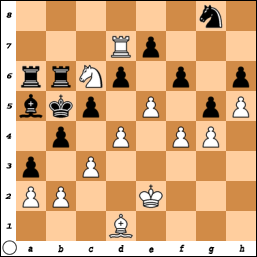
6n1/3Rp3/rrNp1p1p/bkp1P1pP/1p1P1PP1/p1P5/PP2K3/3B4 w - - 0 1
White to play and draw
1.Ba4+ Kxa4 ( 1...Kc4 2.Bb3+ ) 2.b3+ Kb5 3.c4+ Kxc6 4.d5+ Kxd7 5.e6+ Kc7 6.f5 1/2-1/2
Frederic Friedel - Back in March 1992 I published the following study in a computer magazine, as a challenge for any machine to get it right.
Fritz & co. display an eight-pawn disadvantage for White. The correct first move is to sacrifice even more material, which is the only way to secure a draw. This is a much more relevant test, as chess engines, playing the white side, will actually select the wrong strategy and lose the game. In the Penrose position computers with "think that White is losing", but they will hold the draw without any problem (I say this without having tested older engines and trying to entice them into capturing a rook and losing the game).
This little recreational pastime of taking the mickey out of chess playing computers has a long history, which will be told at a later stage. I must admit: it is getting harder and harder as these things get stronger and stronger.
http://en.chessbase.com/post/a-chess...-consciousnessLeave a comment:
-
Re: A chess problem solvable by intuition but not by computers
In my opinion the Rudolph position cited by Frederic Friedel on the ChessBase website is much better evidence for Penrose's thesis. As noted by several readers here, the top chess programs can *play* the Penrose position correctly, even though their numeric assessments favour Black. But none of my programs will play the Rudolph position correctly. As noted by Friedel, this is partly because the correct line involves the immediate loss of even more material. The programs do not understand the concept of a total blockade, which I take to be Penrose's thesis. They all insist that Black is winning easily and their moves reflect this.Last edited by Dan Scoones; Tuesday, 21st March, 2017, 11:53 AM.Leave a comment:
-
Re: A chess problem solvable by intuition but not by computers
I wish I did have a PHD in physics. It was my minor when I got my undergrad degree in molecular genetics (Biology) at the U of A in 1984. I did have offers to continue on to grad school but wanted to get back into the real world. I enjoy reading about physics as a hobby. In my post I was trying to say besides lay people like myself physicists seemed to have made the same error. Some years ago they did variations of the double slit experiments that many believed disproved the pilot wave theory but more recent experiments have helped put those objections to rest.Originally posted by Garland Best View PostLeave a comment:
-
Re: A chess problem solvable by intuition but not by computers
No problem Sid. Is your PhD in Physics? I wasn't able to confirm for sure looking on-line. Kudos for getting the PhD. I only got as far as earning my Masters before deciding that a PhD was not in the cards for me. Academia had little appeal for me at that level.
I would assume that Dirac's Equation is equally applicable to pilot wave theory, although I have not researched it. Of course general relativity still remains the key problem. As to faster than light speeds, given what we have learned regarding inflation, non-local affects and FTL speeds all appear possible.
I especially like Pilot theory, because it removes the need for an observer and the "collapse of the wave function". The Schrodinger's cat paradox goes away.Leave a comment:
-
Re: A chess problem solvable by intuition but not by computers
Garland, thank you for this interesting information, I stand corrected as apparently as do many physicist's in assuming that the Bell inequality implies something more then ruling out that additional variable formation must be non local.Originally posted by Garland Best View Post
The Pilot Wave theory strikes me as a throw back to the days of Michelson Morley who wanted to prove that some sort of Universal ether exists that governs how things interact with each other. Indeed in both the Pilot Wave model and the Copenhagen model the EPR paradox is still a problem where some sort of communication at superluminal speeds exists and in fact experimemtal results amazingly support this that contradicts experimental results supporting special relativity that ruled out the the concept of the ether, faster then light speeds, and sadly was proven correct by among other things the viablity of nuclear bombs.Leave a comment:
-
Re: A chess problem solvable by intuition but not by computers
Thanks. I enjoyed that.Leave a comment:
-
Re: A chess problem solvable by intuition but not by computers
Originally posted by Garland Best View Post
Given all that, how can we account for any consistency in human behavior? Why wouldn't that same breeze make one change from being politically left to politically right....sometimes?
If the probability you mention reaches 100% at certain levels of input, could the brain be feeding certain neurons with the level of stimulation required to ensure those neurons fire (in response to some outside stimuli)? And if yes, could it be that during infancy and childhood, the brain is feeding specific neurons with a lower stimulation level in order to allow them to "possibly fire".... and for the neurons that do fire, if another part of the brain decodes the outcome as "good" or at least "not bad", something in the brain "remembers" that those particular neurons should be supplied with the REQUIRED stimulation to fire from that point on in response to the same stimuli? Could this be the process of learning?
Perhaps in your example the "decision" of an individual bacteria of when (if ever) to switch from metabolizing glucose to metabolizing fructose as the fructose to glucose ratio increases is akin to an individual roll of N 6-sided dice. The individual roll could sum up to any total between N and (N*6) inclusive at any time, so that roll has "free will". But as you increase the number of times rolling the N dice, a consistent and repeatable probabilistic pattern of outcomes emerges, just as the several million bacteria will decide in a consistent and predictable pattern based on the actual fructose to glucose ratio.Originally posted by Garland Best View PostLeave a comment:
-
Re: A chess problem solvable by intuition but not by computers
As far as i know, John Bell supported the de Broglie-Bohm pilot wave theory up until his death. It satisfies Bell's Theorem. Bell's experiments in 1972 dealt with the EPR paradox..
In Bell's own words in 1987, "But in 1952 I saw the impossible done. It was in papers by David Bohm. Bohm showed explicitly how parameters could indeed be introduced, into nonrelativistic wave mechanics, with the help of which the indeterministic description could be transformed into a deterministic one. More importantly, in my opinion, the subjectivity of the orthodox version, the necessary reference to the ‘observer,’ could be eliminated. …
But why then had Born not told me of this ‘pilot wave’? If only to point out what was wrong with it? Why did von Neumann not consider it? More extraordinarily, why did people go on producing ‘‘impossibility’’ proofs, after 1952, and as recently as 1978? … Why is the pilot wave picture ignored in text books? Should it not be taught, not as the only way, but as an antidote to the prevailing complacency? To show us that vagueness, subjectivity, and indeterminism, are not forced on us by experimental facts, but by deliberate theoretical choice?" Refer to https://plato.stanford.edu/entries/qm-bohm/
Another reference: "Finally, and most significantly, Bohm’s theory has been neglected by physicists who thought that additional variable theories had been proven impossible. Impossibility theorems, like the one produced by John Bell [...] were widely interpreted to forbid additional variables in quantum mechanics. What these theorems actually show is that additional variable formulation of quantum mechanics must be nonlocal, and that “quantum theory itself is irreducibly nonlocal.” To cite Bell’s inequality as something that forbids additional variables is to show a gross misunderstanding of the theorem. When it comes to ruling out additional variable theories, the theorem is empty and irrelevant." See https://www.quora.com/Why-dont-more-...ot-wave-theory
So Sid my "belief", as you call it, has not been disproven by evidence. Pilot wave theory is still valid.
And for the non-scientists who want to learn more about pilot wave theory, see the following:
https://www.youtube.com/watch?v=WIyTZDHuarQ
https://www.youtube.com/watch?v=RlXdsyctD50Leave a comment:
-
Re: A chess problem solvable by intuition but not by computers
So did John S Bell , unlike yourself he actually did not just say he "believed" something, he wanted to back up his beliefs with evidence. He conducted famous experiments where the results completely supported the Copenhegan interpretation much to his chagrin!Originally posted by Garland Best
There has always been a fundamental assumption in the strange subatomic world of Quantum Mechanics...if no observers for anything... it does not exist. Einstein in the 1930s found the notion that the "moon does not exist if no one sees it" to be very bothersome.
The mathematics behind Quantum Mechanics are based on this notion that in fact the very act of observing affects the outcome.
Around 1964 a physicist named John S Bell basically came up with the idea that if you make assumptions that certain properties exist even though you can't observe them that the results of any physical experiment that you perform will never match the results that would be predicted using Quantum Mechanics Model that is based on assumptions that such properties do not exist unless they are observed.
So experiments were performed that as an example if you run photons through a polarizer at three different angles you can assume that depending on which of the three angles a photon is run through you would expect the chances of two photons in a row hitting the same polarization is at least one in three. The main assumption you are making is that these photons have hidden properties in them that cause them to bounce off of the polarizer at one of three angles even though you have not observed if the photon have these "hidden variables" ...(preprogrammed) to bounce around at one of three angles when it hits the polarizer set at these angles.
Intuitively John S Bell thought it was perfectly reasonable to make assumption that things exist even if you have not observed them.
Well in fact Quantum theory makes the opposite assumption that no such hidden variables exist as they have not been observed thus the mathematics is very different in predicting the outcome of such an experiment and actually predicts a probability of less then 33% more like 25%. (at certain combinations of three angles).
So The Quantum Mechanics model predicts a result that intuitively makes no sense and supports the notion that if "no one observes the moon it does not exist".
Well experiments similar to these were actually conducted and completely vindicated the Quantum Mechanical model and its predictions.
John S Bell was crestfallen and said the following in 1972 after experiments with a different set up then described above (same idea) were performed that supported the non intuitive outcome.
" For me, it is so reasonable to assume that the photons in those experiments carry with them programs, which have been correlated in advance, telling them how to behave. This is so rational that I think that when Einstein saw that, and the others refused to see it, he was the rational man. The other people, although history has justified them, were burying their heads in the sand. ... So for me, it is a pity that Einstein's idea doesn't work. The reasonable thing just doesn't work."
So the next time you are asked if a tree falls in a forest and no one is around to hear it is a sound made? ,,,,,The answer in the Quantum world is no!
The implications of John S Bell's work has been profound. In 2008, the John Stewart Bell Prize was created by the Centre for Quantum Information and Quantum Control at the University of Toronto.
We have now see even stranger experimental results predicted by the Copenhagan model including pairs of sub atomic particles that appear to influence each other at superluminal speeds, a result that contradicts special relativity itself.
The more data we get seems to underscore how little we know.
More to the point of this thread, one of my favorite books on artificial intelligence called "How to Create a Mind" by Ray Kurzweil who makes a convincing argument that the human brain works with probabilistic hierarchical classifying structures very similar to the way Bayesian is used in many AI based software programs including Watson.
In our own company we take in the entire "firehose" twitter datafeed consisting of over a billion tweets a day and we filter out and convert the data into pre mainstream breaking news stories and automatically assign these stories to the relevant publicly traded companies. We even grade the sentiment for each tweet with 95% accuracy using Bayesian hierarchical classifiers to grade the tweets.
When a human brain looks at an image such as the letter B it has a hierarchical list of probable patterns that match the letter B. Before you have even seen the entire letter the brain fills in the rest of the picture.
When looking at the chess problem the brain immediately sees a pattern where almost all the pieces are bottled up and can do no harm unless unleashed and that the bishops are only on one color and thus can do no harm the king. The approach in a computer for this type of problem has to be a type of Bayesian pattern recognition.
Here is an article for non scientists and non mathematicians that nicely explains John S Bells theorem.
http://drchinese.com/David/Bell_Theorem_Easy_Math.htmLast edited by Sid Belzberg; Sunday, 19th March, 2017, 03:29 PM.Leave a comment:
-
Re: A chess problem solvable by intuition but not by computers
https://vimeo.com/75647511Originally posted by Garland Best View PostLeave a comment:
-
Re: A chess problem solvable by intuition but not by computers
I'm going to give my personal thoughts on this subject, and it's going to be long and wander off into a number of topics, so forgive me for writing a PB style post.
The brain is "quantum" insofar as you a neuron will not always fire the same way under identical circumstances. Instead there is a probability that a neuron will fire that increases as the amount of stimulation increases. This probability function is fairly well understood by neuroscientists. Subject neuron to X1, X2, X3 levels of dopamine to its receivers and Y times out of 100 it will fire.
Adding to this is chaos theory. Microscopic changes in inputs lead to macroscopic changes in output. Given that the human body is subject to literally billion of inputs, it may very well be that a breeze going by your left big toe made you decide to have oatmeal for breakfast this morning instead of eggs.
I buy into adaptive neural networks as the best model for describing how the brain functions, as physically, that is what the brain is - a massively complex collection of neurons networking together. It astounds me that our DNA somehow contains all the rules to organize our brains network of neurons to do what it does from birth. Suffice to say it's one of the reasons that I believe that evolution and the existence of God can coexist.
But what I don't buy is the idea is that the brain/neuron is a quantum computer, with the organic equivalent of qubits running around the brain, giving it insight that a conventional computer cannot derive for ages. It isn't necessary to describe how the brain functions, and to date the arguments for this strikes me as close to mysticism. As an aside, I don't agree with the Copenhagen interpretation of quantum physics, and think instead that the pilot wave paradigm probably better describes reality.
Back to chess, I believe that chess programmers are already utilizing neural networks to some degree. i recall reading that the creators of Komodo had it play a massive number of games to have it "learn" how to play better. Certainly they have to be looking at projects like Alpha-go and Watson and trying to adapt some of their approaches to chess. At some point it will almost certainly lead to a program that assesses the position given in this thread as 0.00 immediately. In the meantime they still kick our butts playing the game against us, so we are getting diminishing returns for our efforts to come you with better programs. Humans can't tell which program is better other than how it plays against other programs.
Now for my aside topic: Consider a bacteria cell as a life organism. One breed of bacteria digests glucose more readily than fructose, so normally the gene that metabolizes fructose is turned off. It will only digest the glucose ignoring the fructose. However as glucose becomes scare and fructose becomes the dominate source of energy, the gene becomes enabled and the bacteria starts digesting fructose.
Scientists have grown millions of these bacteria, all with identical DNA, with indicators to make visible when this gene turns on and off. You can see how in a perfectly uniform glucose/fructose mixture some bacteria activate the gene while neighbours do not. The percentage of bacteria the activate the gene compared to the concentration of fructose follows a well defined curve. The curve can be derived based on energy models of chemical reactions, etc.
So here is my question: Given this, does an individual bacteria experience "free will"? Does it "decide" to eat fructose instead of glucose? If your answer is no, then I would conjecture that human beings do not have free will either. What makes a neuron decide to fire is no different that what makes a bacteria decide to consume glucose. The brain is simply a huge collection of neurons, subject to these chemical laws. It is simply the complexity of the brain that makes what we decide to do appear to be "free will".
This concludes my ramblings for today.Leave a comment:
-
Re: A chess problem solvable by intuition but not by computers
I'm not emotional or overreacting. I call it like I see it. Always. Both the stupid and intelligent. Some posters might not appreciate and I couldn't care less. And this place would probably be much more entertaining if everyone did the same, leaving personal biases and pride out of the discussions.Originally posted by Paul Bonham View PostLast edited by Mathieu Cloutier; Sunday, 19th March, 2017, 10:55 AM.Leave a comment:
-
Re: A chess problem solvable by intuition but not by computers
Originally posted by Mathieu Cloutier View Post
I must say, you're being quite civil towards me considering our past interactions here. Usually I can count on you getting emotional and launching hate-laced invectives towards me. Perhaps there is a new, more mature Mathieu Cloutier emerging like a butterfly from a cocoon. Perhaps you and I could actually sit down over a few beers someday and discuss neural nets and quantum physics and probability and all the rest. Beers are on you! :D
You are correct that I do consider neural net with feedback to be the most likely model of human learning. Along with some genetics: I believe some learned behaviors and abilities are coded into our genes (similar to how spiders can inherit not only the ability to spin webs, but also all the knowledge of how to do it and even the instinct to do it). In fact, I believe that we each inherit genetically -- to varying degrees -- the ability to do things like pattern recognition. Some of us do it better than others, and this difference may be partially due to upbringing, but is more strongly due to genetics imo. Which, now that I think of it, brings up the question: are there some spiders that have more difficulty knowing how to spin webs than other spiders? Interesting!
Nevertheless, we can each learn to do anything better via training (tapping into the neural network feedback mechanism that is in our brains). **
So I'll admit that Penrose's conjecture of quantum effects happening in the brain seems quite a bit suspect. But you said in this thread that his theories on this have been totally debunked. My question to you is: how does ANY hypothesis having to do with quantum physics get debunked? We understand so little about quantum physics, how can we debunk anything in that realm? His "zero success" at proving any of his theories may only indicate that proving anything in quantum physics, and especially pertaining to working human brains, is incredibly difficult.
Perhaps Penrose is just some kind of opportunist; I haven't followed him and my defense of him in this thread has nothing to do with him personally. It has to do only with the questions I just asked.
All I'm suggesting to you is to not let emotion or bias cloud your judgement so much. You obviously don't like Penrose. I don't even care what the reason for that may be, I'm just saying learn to set that aside and approach his quantum physics / brain theories with an open mind. I think it is an interesting question as to whether quantum physics plays any role in the brain, and I wish him well in determining an answer to that (the issue of public funding for his research is a separate issue for U.K. voters to decide).
** I wonder: why do toddlers / children learn so much better via training than adults? Is the human brain's "rewiring" capability much better at younger ages, and if so, how? Are the brains of adults much more "rigid" than the brains of young children? If yes, is there any way to change that for an adult -- i.e. to make an adult brain as capable of being trained as that of a young child??? Anyone who could find a way to do that would become an instant billionaire, I would think. Hypnosis springs to mind but I don't know of any billionaire hypnotists.Leave a comment:
Leave a comment: