

Originally posted by Mathieu Cloutier
View Post
Before I respond to Mathieu, I have a question about this problem that no one has brought up yet:
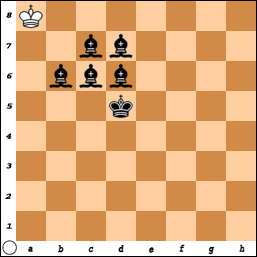
Why does it require 3 dark-square Bishops for Black? Why don't 2 Black dark-square Bishops suffice to demonstrate the problem? Perhaps Wayne Komer, in your analysis, you have found something that indicates Black does require all 3 dark-square Bishops?
Now to Mathieu:
You are misunderstanding the point. You say "all computer engines will play correctly for both sides." That isn't the issue here. The issue is whether ANY computer engine will ASSESS correctly this position. And what Penrose says about that is that for any engine to ASSESS the position correctly, would require more computer resources than exist on planet Earth.
Penrose isn't "trying to fool gullible people". What a ridiculous assertion.
Human beings, even far below GM strength, even below Master strength, can asses this position correctly in a very short time. The reason they can do this is because their brains act in a neural net fashion (and by the way, in everything I've seen on this problem including the Telegraph article, no one has yet mentioned the term "neural net" -- very surprising). This means that humans of reasonable chess strength have fully understood the rules of chess, including the 50 move rule. When a human chess player sees this position and understands that only the Black Bishops can move, and cannot cover any light squares, and the White King can simply meander among the light squares, they reach the conclusion: that means 50 move rule.
But chess engines are not programmed to reach any such conclusion. All chess engines are brute force / minimax search engines (although perhaps there are some unknown neural net engines out there that are "in training"). Chess engines are programmed to find best move. Their assessment of a position is a result of doing a minimax search of the move tree, unless the engine is told to use endgame tablebases.
For any chess engine to determine that 50 move rule comes into play: since it is told nothing about past moves, it means 50 moves per player have to transpire with no captures / pawn advances for the engine to asses 50 move rule applies. 50 moves per player means 100 plies, and a 100 ply search where just the 3 dark-square Bishops can move for Black would most likely require, if using pure minimax algorithm, as Pensrose said, more computational resources than exist on Earth.
But wait... somewhere in this thread, Egidijus Zeromskis made this point:
"Thus we left with White king and three Black bishops to dance around for a 50 moves rule. That's in a principle 4 piece tablebase. Should be solve-able for a decent computer in a blink (with proper programming)"
Very good point, Egidijus. But there's a remaining problem: normally a chess engine only uses tablebases in the endgame phase! This position does NOT represent an endgame phase... although it could, if you had a heuristic for that which I mentioned in a previous post. But somehow, you the author of the chess engine code have to tell the engine when to use tablebases. And guess what: the possible times when that can occur is totally unpredictable. The number of heuristics you'd have to code into that engine to tell it when to switch from a minimax search to using tablebases is beyond comprehension.
The only type of chess engine that can possibly emulate the workings of the human brain is a neural net chess engine. I'm surprised that Penrose (at least in the Telegraph article) doesn't mention that. And such a neural net engine would't just automatically know what to do. It has to be trained, just as the human brain has to be trained since childhood to play chess.
So despite what Mathieu says, there is a difference here. This problem does demonstrate human ingenuity versus the rigid inflexible workings of all typical computer chess engines. And let's not forget: the same human who recognizes in 5 minutes or less that this position is a draw.... can in the same day go out and win a tennis match using totally different thinking and totally different functionality.. Try that, computer chess engine!
Leave a comment: